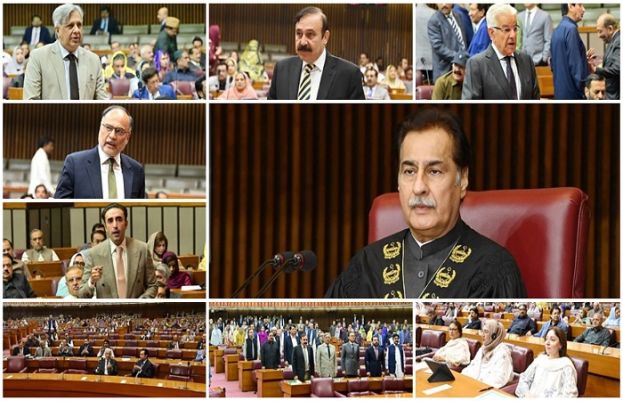

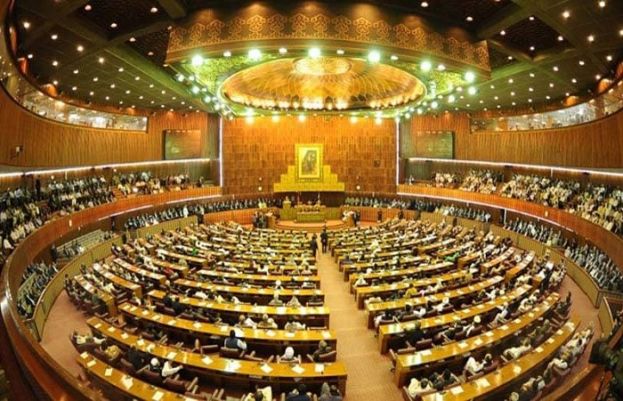
Parliament has ratified the imposition of a state of emergency and Governor’s Rule in Khyber Pakhtunkhwa (KP), with the resolutions passed by a majority vote during a joint session chaired by National Assembly Speaker Ayaz Sadiq. Deputy Prime Minister and Foreign Minister Ishaq Dar defended the measures, saying the government had fulfilled all constitutional requirements. Federal Minister for Parliamentary Affairs Tariq Fazal Chaudhry said the decision followed detailed deliberations and was taken in response to terrorism and a lack of cooperation from the KP government. The resolutions seeking ratification of the emergency and Governor’s Rule were presented by Federal Minister for Parliamentary Affairs Dr Tariq Fazal Chaudhry during the joint session. Both measures were approved by a majority vote. Dar said the National Assembly and Senate had already approved the motions a day earlier under Article 232 of the Constitution, and the matter was brought before the joint session again for ratification. “The action taken in Khyber Pakhtunkhwa is in line with the Constitution,” Dar said, adding that the emergency and Governor’s Rule had been imposed in accordance with constitutional provisions. He stressed that Article 232 should not be interpreted merely for personal or political convenience and said the government had fulfilled all requirements under the article. He also referred to Article 234, saying its provisions were clear and had been implemented accordingly. Dar added that Interior Minister Mohsin Naqvi had already explained the situation in considerable detail before Parliament. Addressing the joint session, Dar said terrorism remained a serious national challenge and called on political parties to prioritise security over political differences. “If we succeed against terrorism, other issues will also be resolved,” he said, adding that the country had paid a heavy price in the fight against militancy and continued to suffer losses. “How many more times will we allow our citizens to be martyred for the sake of our own politics?” Dar asked. He added that if Pakistan failed to tackle terrorism now, it was unclear when the country would be able to do so. Dar said the government had convened an All Parties Conference (APC) to discuss the security situation, with all political parties, including the Pakistan Tehreek-e-Insaf (PTI), participating. According to Dar, the APC produced a jointly formulated National Action Plan, under which military operations Zarb-e-Azb and Radd-ul-Fasaad were conducted. He said these operations forced terrorists to flee across the border. He questioned who had facilitated the militants inside Pakistan and who had authorised the return of Tehreek-e-Taliban Pakistan (TTP) members to the country. Dar claimed that permission had been granted for between 40,000 and 45,000 TTP members to return to Pakistan, arguing that decisions of this nature had contributed to the resurgence of terrorism. He said those responsible for what he described as flawed decisions should be held accountable for the consequences. The deputy prime minister also referred to efforts to restart negotiations with militants, saying Maulana Fazlur Rehman had suggested attempting talks once again. According to Dar, Prime Minister Shehbaz Sharif told Fazlur Rehman that the situation had already progressed too far. The prime minister also informed him that the matter had been placed before the federal cabinet. Dar said there had been resistance to even mentioning the term “TTP” in the relevant context, adding that Afghanistan’s interim government did not use the term either. He further claimed that activities attributed to the TTP were being carried out by the Balochistan Liberation Army (BLA) and other groups. Dar said Pakistan possessed evidence of terrorism and had already presented it to international bodies. Dar also addressed criticism of the government’s constitutional actions, saying, “No one should lecture us; we have always upheld the Constitution.” He reiterated that the Senate and National Assembly had approved the imposition of the emergency and Governor’s Rule, and maintained that the measures in KP had been taken in accordance with the Constitution. The deputy prime minister said the government had met the requirements of Articles 232 and 234 and rejected the suggestion that the constitutional provisions should be interpreted selectively. During the session, Dar also referred to meetings between former prime minister Imran Khan and his wife, Bushra Bibi, saying that her meetings with the PTI founder were taking place regularly. Federal Minister for Parliamentary Affairs Tariq Fazal Chaudhry defended the decision to impose the emergency and Governor’s Rule, saying it should not be viewed as a victory or defeat for any political party. He said the government had considered statistics relating to terrorism before making the decision and had been indicating for the past 10 to 15 days that it was seriously considering emergency measures. According to Chaudhry, the emergency and Governor’s Rule were imposed because of a lack of cooperation from the KP government. He rejected the impression that the decision had been taken hastily, saying detailed discussions had taken place before the government proceeded with the measures. The parliamentary proceedings mark a significant development in the federal government’s handling of the political and security situation in Khyber Pakhtunkhwa, with the government maintaining that its actions are constitutionally justified and necessary to address terrorism.