
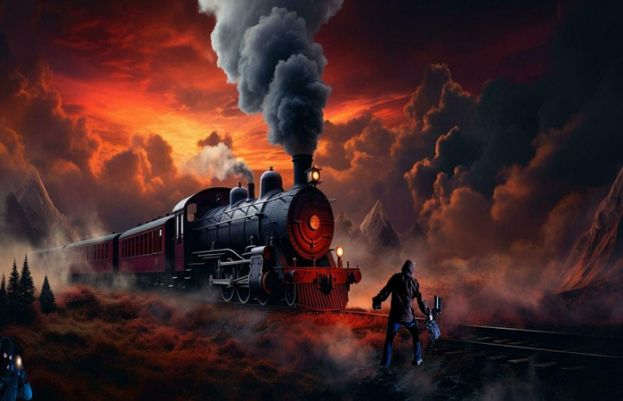
The Great Train Robbery was a planned robbery in which a group of 15 criminals managed to stop a Royal Mail train traveling from Glasgow to London and escaped with a huge amount of money. The train was carrying cash and valuables, with a total estimated value of 2.6 million pounds. Planning and preparation:The gang spent months planning the robbery. They had inside knowledge of Royal Mail operations and knew which route the train would take. They learned that the train would be carrying a large amount of cash on a specific date. Signalman:The robbers stopped the train near a place called Cheddington, Buckinghamshire. One member of the gang was working at the signal box, where he misled the train crew by changing the signal, diverting the train onto a deserted track where the robbers were waiting. Train Hijacking:The robbers quickly boarded the train, overpowering the crew. They used a combination of force and intimidation. There was little resistance from the crew as the criminals were well prepared. They took control of the train, which was carrying 75 tons of cash. The loot:The money was in the form of cash crates that weighed a lot. Despite the robbers’ best efforts to create a clear route, the loot was heavy, and it was not easy to move. They loaded the money onto a truck and fled the scene, heading to a remote location where they distributed the cash. Escape route:The robbers fled to a deserted farmhouse in the countryside where they hid for several days. They also used various false identities and changed their appearances to avoid detection. Outcome and investigation: Hunt:The police launched a large-scale manhunt after the robbery. Initially, the robbers fled with it, and there was much speculation about their whereabouts. However, they made some key mistakes that ultimately led to their arrest. Mistakes and Clues:The criminals were careful, but left some evidence behind. For example, one gang member was caught while trying to deposit a large sum of money into a bank account under his real name. Additionally, some of the robbers were seen by witnesses, and this led to their eventual identification. Arrest:In the weeks and months following the robbery, police caught most of the gang members. Many were arrested and given long prison sentences. Some gang members were never caught, and the ultimate fate of some of the stolen money is still unclear. Legacy:The robbery was considered an incredible feat of planning and execution. It captured the public imagination and inspired numerous books, films, and documentaries. The criminals behind the robbery became notorious, many of them going down in history as some of Britain’s most notorious criminals. Why it was so famous: Planning and execution: The level of detail in the planning of the robbery, and how smoothly it was executed, was astonishing. It shows how well the criminals worked together and how carefully they studied the Royal Mail’s operations. Scale of the theft: £2.6 million was a huge sum at the time. To put this into perspective, when adjusted for inflation, it’s over £50 million today. Public attention: The story of the robbery captured the public imagination. The robbers were seen by some as folk heroes, and the media loved to cover the drama, especially with law enforcement pursuing the criminal masterminds. Robbers: Although the criminals who pulled off the Great Train Robbery were never organized crime “syndicates,” their crimes had ties to the criminal underworld. Most of them were involved in petty crimes such as theft or fraud. After the robbery, several were caught, tried, and sent to prison.