
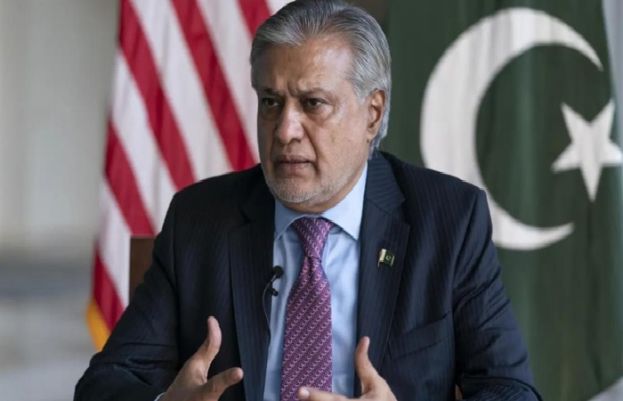
Deputy Prime Minister and Foreign Minister Ishaq Dar has confirmed that indirect talks between the United States and Iran are under way through messages being relayed by Pakistan, with Turkiye and Egypt also helping in the effort. “There has been unnecessary speculation in the media regarding peace talks to end [the] ongoing conflict in the Middle East,” he wrote on X on Thursday, confirming that indirect talks were underway through messages being relayed by Pakistan. The deputy premier further said that Iran was deliberating upon 15 points shared by the United States. “Pakistan remains fully committed to promoting peace and continues to make every effort to ensure stability in the region and beyond,” he said, reiterating that “dialogue and diplomacy” was the only way forward. The remarks come amid efforts to open a window for diplomacy to end the nearly month-long war between the US, Israel, and Iran, which began on February 28 and has affected the broader Middle East. Pakistan, working closely with Turkiye and Egypt, has played a key role in back-channel diplomacy, relaying messages between Washington and Tehran to prevent further escalation and maintain regional stability. These efforts included direct contact between Chief of Defence Forces (CDF) and Chief of Army Staff (COAS) Field Marshal Asim Munir and US President Donald Trump on Sunday, confirmed by the White House. Prime Minister Shehbaz Sharif also announced that Pakistan was ready to host talks between the US and Iran, a move acknowledged by President Trump, who reposted the statement on his Truth Social account. Subsequently, Pakistan delivered a US proposal to Iran, a senior Iranian source told Reuters on Wednesday. The source did not reveal details of the proposal or confirm if it was the 15-point US framework reported by media outlets. Turkiye is also reportedly helping explore avenues to end the war, with either Pakistan or Turkey under consideration as the venue for talks, the source said. In a latest development, Iran has rejected the US proposal, insisting it will end the ongoing “imposed war” on its own terms and timeline, a senior political-security official told Press TV. The official compared the latest overture with two previous rounds of negotiations in spring and winter 2025, which were accompanied by US military operations, framing Tehran’s response as consistent with its longstanding caution. Iran outlined five conditions for ending the war: a complete halt to “aggression and assassinations”; mechanisms to prevent the war from being reimposed; guaranteed payment of reparations; resolution across all fronts and resistance groups; and international recognition of Iran’s control over the Strait of Hormuz. A day earlier, US President Donald Trump said Iran was desperate for a deal to end nearly four weeks of fighting, contradicting the Iranian foreign minister who said Tehran was reviewing a US proposal but had no intention of holding talks to wind down the war. ‘Pakistan in contact at both regional, global levels’ Speaking at a weekly press briefing, Foreign Office Spokesperson Tahir Andrabi said that Pakistan was in contact with countries at both regional and global levels for de-escalation in the Middle East. He said Islamabad held consultations with the leadership of Turkiye, Jordan, Kuwait, Azerbaijan, Malaysia, Egypt, Bangladesh, and Lebanon as part of its ongoing diplomatic outreach. He said that contacts have also been established with leaders from Bahrain and Indonesia, where views were exchanged on the evolving regional situation. Prime Minister Shehbaz is personally leading communications with key stakeholders in the region and beyond as part of Islamabad’s efforts to de-escalate the tensions in the Middle East, the FO spokesperson said. Andrabi said that DPM Dar was also maintaining continuous contact with counterparts at both regional and global levels. “Pakistan is pushing for an immediate reduction in tensions, a ceasefire, and a peaceful resolution.”